How real businesses scale through systems
Business Growth Architect - Why work with Mack Bhatia
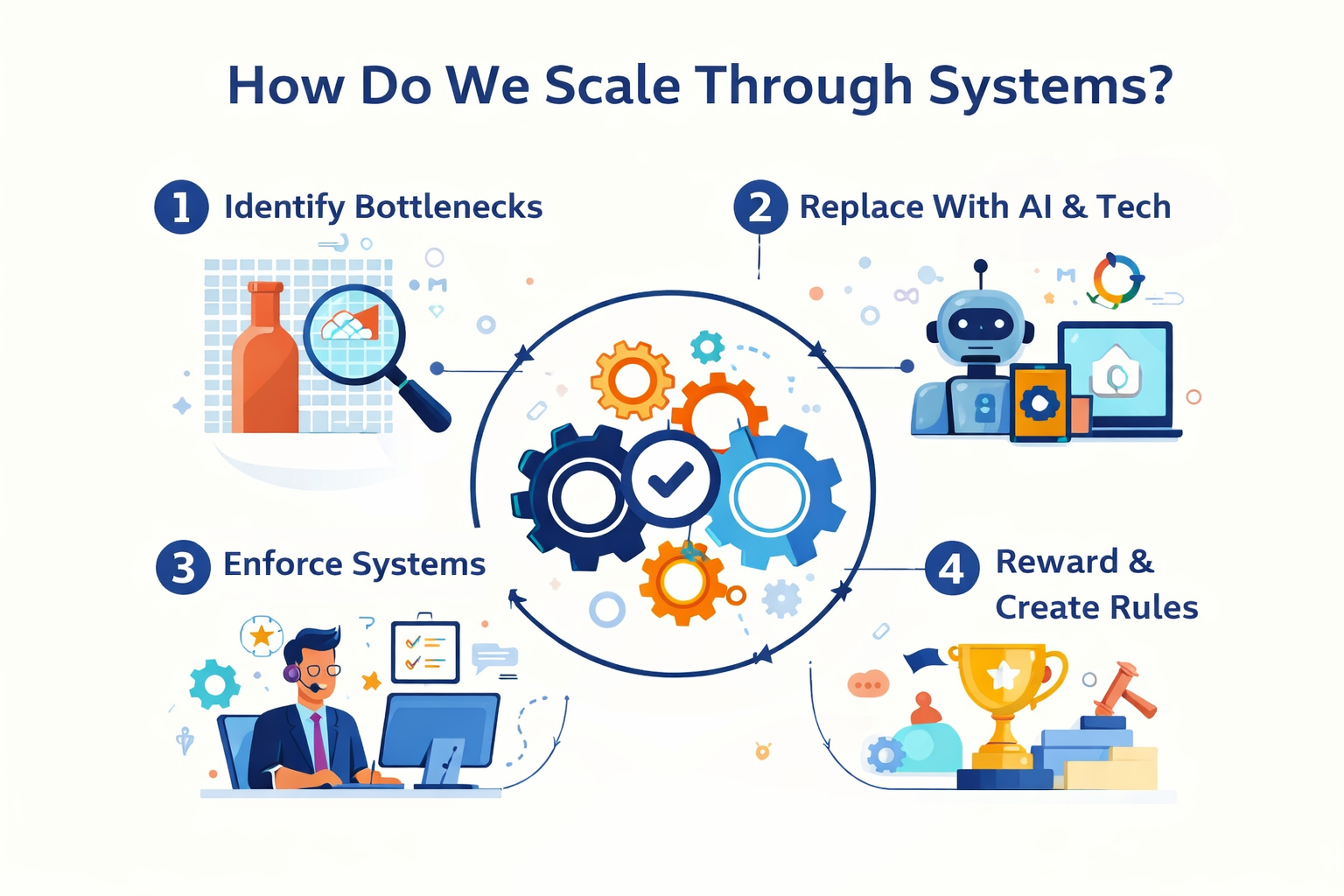
How Do We Scale Through Systems?
A lot of businesses say they want growth. What they really want is more revenue without more chaos. Because growth without systems is not scale. It is stress.
When a company is small, talent, hustle, and founder energy can cover a lot of mistakes. People jump in, fix things manually, and keep the business moving. But as volume increases, cracks begin to show. Tasks get repeated inconsistently. Customers get different experiences. Decisions become dependent on memory instead of process. Teams start solving the same problem again and again.
This is where real scale begins: not with more effort, but with better systems.
1. Identify the bottlenecks and inefficiencies
Every company has them. A bottleneck may be a person who has become the only one who knows how something works. It may be a manual workflow that takes too long. It may be approvals that sit idle, customer service that reacts instead of sells, reporting that arrives too late, or teams duplicating effort because nothing is standardized.
Most businesses do not fail because people are lazy. They struggle because too much depends on informal workarounds. If you want to scale, the first step is to look honestly at where time, energy, and opportunity are being lost.
Ask simple questions:
- Where do things slow down?
- Where do errors happen repeatedly?
- Where are we relying too much on one person?
- What tasks are being done manually that should not be?
- Which activities create motion but not progress?
- Scale begins when leadership stops tolerating friction as “normal.”
2. Remove what is not working and replace it with better technology and AI systems
Once bottlenecks are visible, the next step is not to protect old habits. It is to replace them.
Too many companies keep broken processes alive because they are familiar. But familiarity is not efficiency. And loyalty to outdated ways of working can quietly cap growth.
Scaling businesses need the discipline to remove what no longer works.
That means: eliminating duplicate steps, simplifying approvals automating repetitive tasks
introducing dashboards instead of chasing updates using AI where judgment can be enhanced, speed can improve, or manual load can be reduced.
Technology and AI should not be added for the sake of trend. They should be introduced where they make the business sharper, faster, more consistent, and more measurable.
The goal is not to replace human value.
The goal is to remove low-value friction so humans can operate at a higher level.
When implemented properly, systems create consistency. AI creates leverage. Together, they free the business from being overly dependent on memory, heroics, or constant supervision.
3. Hire people who monitor, protect, and enforce the systems
A system is only as strong as its operating discipline. Many businesses make a mistake here. They invest in software, automation, and process design, then assume the work is done. It is not.
Systems do not sustain themselves. They need ownership.
To scale properly, you need people who do more than execute tasks. You need people who monitor performance, catch breakdowns early, enforce standards, and ensure that the system is being followed the way it was intended. This is not bureaucracy, This is operational maturity.
The right people help answer questions like:
- Are the workflows being followed correctly?
- Are the automations still accurate?
- Are teams bypassing the system?
- Are service levels slipping?
- Are exceptions becoming the norm?
When no one owns system integrity, even the best-designed operation slowly degrades. Workarounds return. Standards weaken. Shortcuts spread. What was once a strong operating model becomes noise. Scaling requires operators who respect structure and protect excellence.
4. Reward people who follow the system — and create rules for those who break it
Culture matters. But culture without accountability becomes suggestion.
If you want systems to drive scale, people must understand that systems are not optional. They are the foundation of how the company operates. That means two things must exist at the same time:
First, reward the people who follow, improve, and respect the system.
Recognize the team members who document well, execute consistently, raise issues early, and operate with discipline. These are often the people quietly holding the business together. If they are ignored while rule-breakers are tolerated, the wrong culture spreads.
Second, establish clear rules and consequences for ignoring or casually violating the system.
Not every deviation is malicious. Some are careless. Some come from habit. Some come from ego. But repeated disregard for systems damages performance, creates inconsistency, and makes scale harder.
A business that wants to grow must make a clear statement:
We do not reward chaos just because someone gets results once in a while.
We reward repeatable performance.
Rules create clarity. Accountability protects standards. Recognition reinforces the right behavior.
That is how discipline becomes culture.
Scale is not built on effort alone, At some point, effort stops being the constraint.
The real constraint becomes whether the business can produce consistent outcomes without depending on constant rescue. That is why great companies scale through systems.
They identify bottlenecks, They remove what no longer works., They replace friction with technology and AI, They hire people who protect operational integrity.
They reward discipline and hold the line on standards. Because scale is not about doing more.
It is about building a business that works better. And when the right systems are in place, growth stops feeling fragile.It starts becoming repeatable.
Recent Posts